
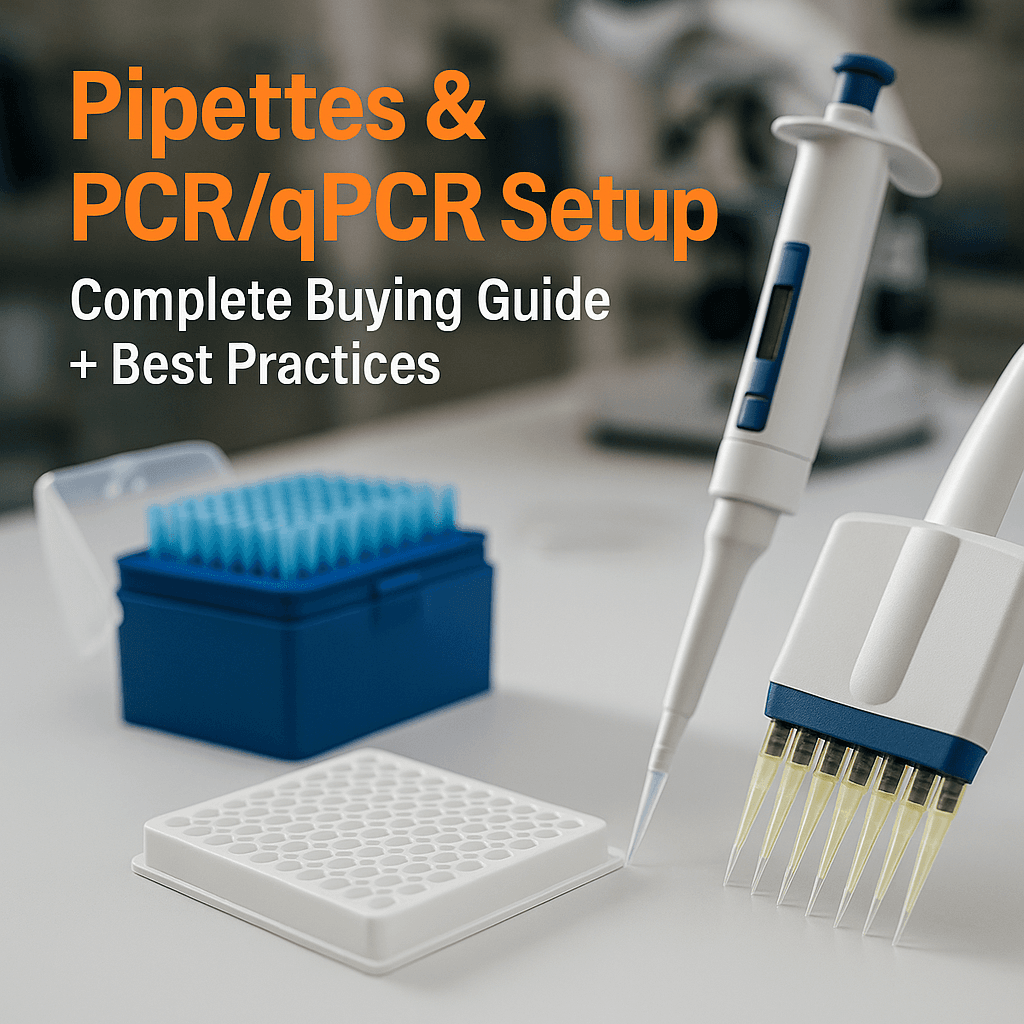
PCR and qPCR Setup: Complete Buying Guide + Best Practices for Accurate Results
PCR and qPCR workflows are among the most precision-sensitive procedures in modern molecular biology. Whether you are preparing DNA, RNA, master mixes, enzymes, primers, probes, or plate-based reactions, accuracy directly determines amplification quality, Ct reliability, and experiment reproducibility.
This guide explains how to choose the right pipettes, tips, and workflow strategies to minimize contamination, reduce variability, and improve amplification performance. The goal is simple: cleaner reactions, consistent Ct values, and reproducible PCR data.
1. Why PCR and qPCR Setup Is Challenging
PCR reagents are highly sensitive, and even tiny pipetting inconsistencies can create measurable differences in Ct values or amplification curves. Common challenges include:
- Very small volumes where even minor deviations disrupt reaction ratios.
- Sensitivity to contamination from aerosols, splashes, or environmental DNA/RNA.
- Enzyme and primer adsorption on non-optimized plastics.
- Master mix viscosity that requires controlled aspiration to avoid bubbles.
- Plate uniformity issues in multichannel workflows.
- Operator-dependent variability that affects qPCR Ct precision.
Key point: PCR is extremely sensitive. The accuracy of your equipment and technique directly impacts amplification results.
2. Choosing the Right Pipette Type for PCR and qPCR
In PCR and qPCR workflows, your pipette mechanism determines volume accuracy, consistency, and contamination control. Here are the best choices:
a) Electronic Pipettes (Best for qPCR Precision)
Electronic pipettes ensure operator-independent accuracy and repeatability. They offer controlled aspiration speed, reduced hand strain, programmable mixing, and multi-dispense modes. This consistency is vital for uniform Ct values.
Use them for: master mix preparation, cDNA setup, primer/probe dilution, RNA handling.
Examples: Eppendorf Xplorer, Sartorius Picus, Gilson PIPETMAN M.
b) Multichannel Pipettes (Plate Consistency)
Consistent plate loading is crucial for qPCR. Multichannel pipettes reduce well-to-well variability and prevent timing delays between rows.
Use them for: 96 and 384 well plates, high-throughput qPCR, ELISA-based DNA quantification.
Examples: Eppendorf Research plus Multichannel, Sartorius Tacta Multichannel, Thermo Scientific Finnpipette Novus.
c) Positive Displacement Pipettes (For Viscous Master Mixes)
Master mixes, enzymes, and high-concentration additives can be viscous. Positive displacement pipettes handle these reagents without air-cushion inaccuracies.
Use them for: viscous PCR master mixes, glycerol-rich enzyme solutions, difficult-to-aspirate templates.
Examples: Gilson Microman E, Eppendorf Varipette 4720, Sartorius Biohit PD Systems.
3. Tip Selection for PCR and qPCR Workflows
Tip quality has a massive impact on Ct consistency and contamination control. Essential features include:
- Filtered tips to prevent aerosol contamination.
- RNase and DNase-free certification for RNA and DNA applications.
- Low-retention plastics for accurate reagent delivery.
- Sterile packaging to ensure clean PCR conditions.
- Precision molding to reduce volume variability.
High-quality tips are essential for Ct reproducibility, accurate pipetting at low volumes, and preventing PCR inhibition.
4. Correct Pipetting Technique for PCR and qPCR
Because PCR involves small volumes and highly sensitive enzymes, proper technique is one of the strongest predictors of experimental success.
- Use slow, smooth aspiration to avoid bubbles in master mixes.
- Pre-wet tips when pipetting master mix or enzyme solutions.
- Keep the pipette vertical when aspirating small volumes.
- Perform reverse pipetting for viscous or low-volume reagents.
- Avoid touching tube rims to prevent contamination.
- Mix gently to avoid enzyme degradation.
- Use consistent pipetting speed for uniform plate loading.
- Change tips between every sample to avoid cross-contamination.
- Always use filtered sterile tips.
- Work in a clean PCR hood to protect against environmental DNA.
If you remember only two rules: slow aspiration + filtered low-retention tips. These alone fix most qPCR variability.
5. Best Pipette Setup for PCR and qPCR Reagents
- Master mixes: Positive displacement pipette + low-retention filtered tips.
- Primers and probes: Electronic pipette + RNase-free tips.
- RNA samples: RNase-free filtered tips + clean hood environment.
- 96 and 384 well plates: Multichannel electronic pipette + sterile filtered tips.
- High-throughput qPCR: Electronic multichannel pipette + consistent plate sealing.
Many labs keep dedicated PCR pipettes that never leave the PCR hood. This reduces contamination risk dramatically.
6. FAQ
Do I really need filtered tips for PCR?
Yes. Filtered tips are mandatory to prevent amplicon contamination and false positives.
Why do my qPCR Ct values vary?
Most commonly from pipetting inconsistencies, bubbles, poor mixing, or inaccurate low-volume delivery.
Are electronic pipettes worth it for PCR?
Yes. Their consistent aspiration speed significantly improves well-to-well uniformity.
Do I need separate pipettes for PCR?
Strongly recommended. Keep PCR pipettes exclusively inside the PCR hood to avoid contamination.
7. Conclusion: Choosing the Right Tools - and Streamlining How You Buy Them
PCR and qPCR setup requires precision, cleanliness, and extremely consistent pipetting. Selecting the right pipette type, tip quality, and workflow dramatically impacts Ct values, amplification curves, and overall data integrity.
In practice:
- Electronic pipettes → most consistent qPCR performance
- Multichannel pipettes → best for plate loading
- Positive displacement pipettes → best for viscous master mixes
The final step is finding certified, reliable models at competitive prices without endless catalog browsing.
Maximize Efficiency with Spyndl’s Procurement Solutions
Spyndl simplifies lab procurement by aggregating supplier offers, standardizing product data, and allowing fast comparisons of technical features and pricing.
Whether equipping a molecular biology lab or supporting high-throughput qPCR workflows, Spyndl helps you source the best electronic pipettes, multichannel systems, and positive displacement models from Eppendorf, Gilson, Sartorius, Thermo Scientific, and more.
Enhance your PCR workflow with:
- Filtered RNase and DNase-free PCR tips
- Low-retention tips
- Plate sealing films
- Pipette calibration tools
- PCR plastics and tubes
Spyndl reduces administrative overhead and helps labs standardize equipment, negotiate better pricing, and streamline molecular workflows.
Want to learn more? Book a demo: Book a demo!