
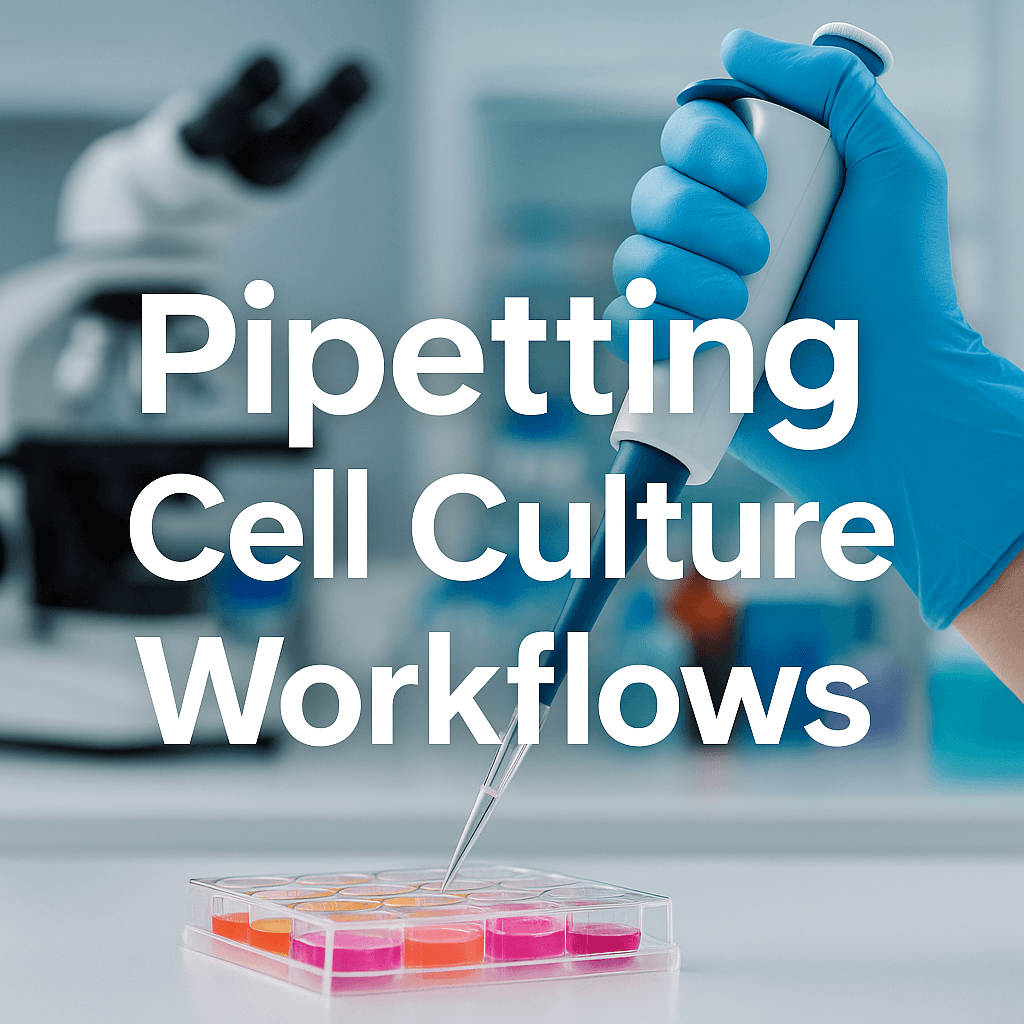
Pipetting for Cell Culture Workflows: Complete Buying Guide + Best Practices
Cell culture is one of the most widely performed techniques in biological and biomedical laboratories. Whether you are seeding cells, performing medium exchanges, preparing reagents, splitting adherent cultures, thawing cryovials, or setting up transfections, pipetting quality directly affects cell health, sterility, and experimental reproducibility.
This guide explains how to choose pipettes and tips specifically for cell culture work, how to reduce contamination, and how to apply techniques that protect both cell viability and experimental consistency. The goal: more reliable cultures, fewer contamination events, and smoother everyday workflows.
1. Why Pipetting in Cell Culture Is Difficult
Pipetting in cell culture involves a unique combination of fragility, sterility requirements, and liquid complexity. Key challenges include:
- High sterility demands inside biosafety cabinets or laminar flow hoods.
- Foaming when pipetting serum-containing media or supplements too quickly.
- Cell fragility especially for primary cells, stem cells, or sensitive lines.
- Viscous reagents such as Matrigel, coating solutions, or transfection mixes.
- Aerosol generation risk when pipetting viral vectors, antibiotics, or cell lysates.
- Frequent repetitive motions leading to hand fatigue and inconsistent technique.
The key idea: cell culture workflows require precision, sterility, and gentle handling to avoid contamination, cell stress, and experimental drift.
2. Choosing the Right Pipette Type for Cell Culture
Pipette selection directly affects sterility, repeatability, and cell survival. Here is the most practical hierarchy for cell culture applications:
a) Electronic Pipettes (Best for Gentle Handling and Repeatability)
Electronic pipettes provide controlled aspiration and dispensing speeds, minimizing shear stress on cells and reducing foam formation. They are ideal for delicate tasks and for high-throughput workflows.
Use them for: media preparation, buffer mixing, seeding, transfections, reagent setup.
Popular models include: Eppendorf Xplorer, Sartorius Picus, Gilson PIPETMAN M. Prioritize models with slow aspiration modes and precise multi-dispense programs.
b) Multichannel Pipettes (Essential for Plates)
Most cell culture work involves 6-, 12-, 24-, 48-, 96-, or 384-well plates. Multichannel pipettes drastically speed up seeding, washing, and assay preparation while improving uniformity.
Use them for: plate seeding, washing steps, medium changes, viability assays.
Typical models: Eppendorf Research Plus Multichannel, Thermo Scientific Finnpipette Novus, Sartorius Tacta Multichannel.
c) Positive Displacement Pipettes (Great for Sticky or Viscous Reagents)
Some cell culture reagents are thick, sticky, or protein-rich. Positive displacement pipettes eliminate errors caused by viscosity and reduce contamination risk.
Use them for: Matrigel, coating solutions, dense protein mixes, viral vectors.
Typical models: Gilson Microman E, Eppendorf Varipette 4720, Sartorius Biohit PD Systems.
3. Tip Selection for Cell Culture Workflows
In cell culture, tip choice directly affects sterility and cell viability. Look for:
- Sterile filtered tips to prevent aerosol contamination inside biosafety cabinets.
- Low-retention tips to prevent protein adsorption from media or supplements.
- Wide-orifice tips to reduce mechanical stress on cells.
- RNase and DNase free tips for molecular steps or RNA workflows.
- Certified sterile tips to meet cell culture QA requirements.
Tip quality plays a major role in reducing contamination, protecting fragile cells, and improving reproducibility.
4. Correct Pipetting Technique for Cell Culture
Good technique is critical for maintaining sterility and cell viability. Standardize the following:
- Work slowly and gently to avoid shearing or foaming.
- Keep pipettes upright to prevent media from entering the shaft.
- Use filtered sterile tips at all times inside the biosafety cabinet.
- Pre-wet tips before pipetting protein-rich media.
- Avoid touching rims to reduce contamination risk.
- Aspirate slowly when handling fragile cells or suspensions.
- Dispense against the wall to avoid splashing and aerosol generation.
- Use consistent immersion depth to improve volume accuracy.
- Change tips frequently especially when working with antibiotics, supplements, or patient-derived cells.
- Standardize movements across the team to maintain reproducibility.
If you adopt only two habits: use filtered sterile tips + aspirate slowly. This prevents contamination and protects cells.
5. Best Pipette Setup for Each Cell Culture Task
- Cell seeding: Electronic pipette + wide-orifice sterile tips.
- Medium changes: Multichannel pipette + sterile filtered tips.
- Transfections: Electronic pipette + low-retention sterile tips.
- Handling viscous matrices (Matrigel, coatings): Positive displacement pipette + PD tips.
- Trypsinization and cell detachment: Air-displacement pipette + wide-orifice tips for gentle handling.
Many labs keep a dedicated set of electronic multichannel pipettes exclusively for plate-based culture work.
6. FAQ
Do I need filtered tips for all cell culture work?
Yes. Filtered sterile tips dramatically reduce contamination risk inside biosafety cabinets.
Are electronic pipettes better for sensitive cells?
Yes. Controlled speed reduces shear stress and improves viability.
Can I use multichannel pipettes for cell suspensions?
Yes, but use wide-orifice tips to prevent shear damage and clogging.
Which pipettes are best for viscous matrices?
Positive displacement pipettes provide the most consistent handling for sticky or thick solutions.
7. Conclusion: Choosing the Right Tools - and Streamlining How You Buy Them
Cell culture pipetting requires sterility, precision, and gentle handling. The right pipettes and tips improve reproducibility, protect cell health, and reduce contamination across your workflow.
In practice:
- Electronic pipettes → best for gentle and repeatable handling
- Multichannel pipettes → essential for plate-based culture
- Positive displacement pipettes → ideal for viscous matrices
Finding the right equipment across multiple suppliers takes time. Spyndl helps you compare pipettes, certifications, pricing, and consumables without digging through catalogs.
Maximize Efficiency with Spyndl’s Procurement Solutions
Spyndl aggregates supplier offers, standardizes product data, and enables fast comparison of technical features, certifications, and pricing.
Whether you are equipping an academic research lab or a biotech cell culture facility, Spyndl makes it easy to source the right electronic pipettes, multichannels, and PD systems from brands like Eppendorf, Gilson, Sartorius, Thermo Scientific, and more.
Complete your workflow with essential culture-grade consumables:
- Sterile filtered tips
- Wide-orifice tips for cells
- Low-retention tips for protein-rich media
- Calibration and verification kits
- Cryovials, conical tubes, and culture plastics
Spyndl helps labs reduce administrative overhead, standardize their pipetting tools, and negotiate better pricing for recurring cell culture consumables.
Want to get to know more? Book a demo!